Filter media is a widely used functional filter accessory in the supporting production of industrial equipment, home appliances, purification equipment, fresh air systems and industrial control enclosures. It is mainly applied for air dust removal, impurity isolation, air duct purification and odor adsorption, while maintaining ventilation and heat dissipation. Many manufacturers often encounter issues such as clogged airflow, fiber shedding and dust emission, rapid blackening and failure, reduced air permeability, poor size matching and loose fitting during bulk supporting, equipment assembly and long-term operation. Most of these problems are not caused by product quality defects, but improper filter media material selection, mismatched pore specifications and insufficient processing precision. To balance filtration performance and equipment stability, material selection must be carried out according to actual working conditions. Zhongke Foam specializes in die-cutting processing of filter media, and can customize various special-shaped filter sheets based on customer drawings, samples and equipment dimensions to meet supporting demands across all industries.
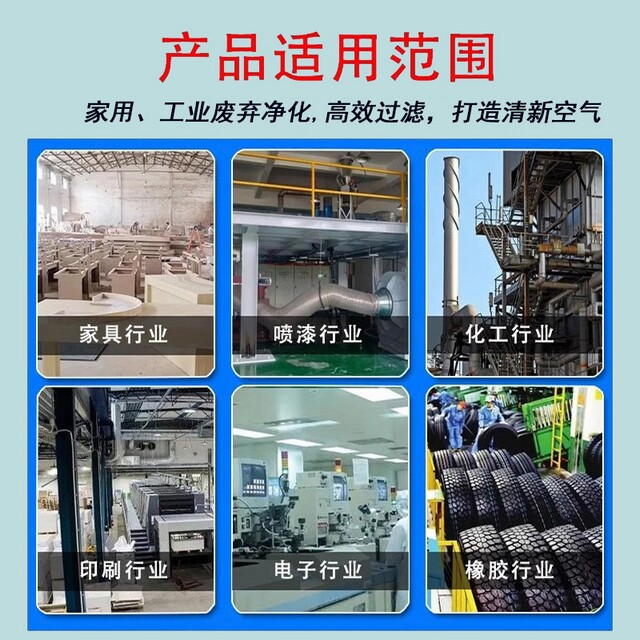
1. Core Classification and Performance Differences of Industrial Filter Media
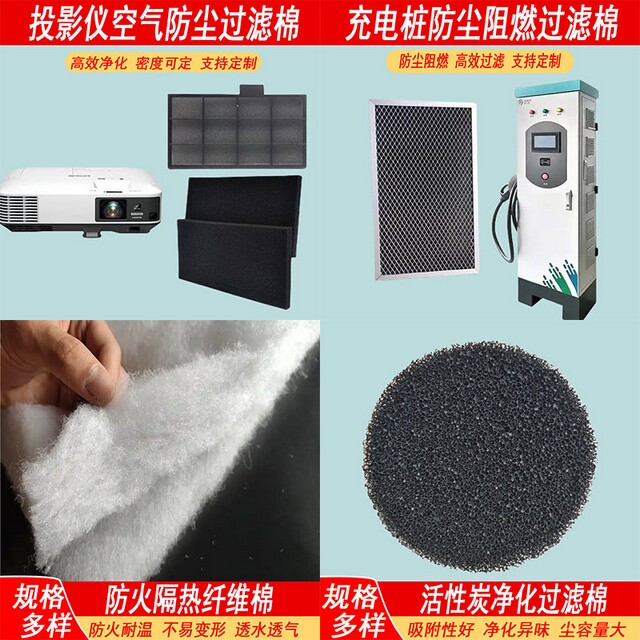
Common industrial filter media on the market are mainly divided into four categories: sponge filter media, primary-efficiency filter media, activated carbon filter media and flame-retardant filter media. They differ greatly in air permeability, dust holding capacity, filtration accuracy and applicable scenarios. Do not substitute one for another in procurement and selection.
· Sponge Filter Media: Featuring an open-cell mesh structure, it delivers excellent air permeability and stable resilience with no powder shedding. It is the mainstream choice for dust prevention of industrial control equipment, fans and electrical appliances. With uniform pores and low air resistance, it will not impair heat dissipation, making it suitable for air duct dust prevention of equipment running continuously for long hours.
· Primary-Efficiency Filter Media: Mostly made of polyester fiber with fluffy fibers and large dust holding capacity. It mainly intercepts hair, flocs and large-particle dust. It is widely used for air conditioner outlets, pre-filtering of purification equipment and air inlet filtration of spray booths. It can effectively protect the rear precision filter screen and greatly extend the service life of the whole machine.
· Activated Carbon Filter Media: Composite with activated carbon particles on the base material, it provides both dust removal and adsorption functions. It can effectively absorb peculiar smells, oil fume and mild harmful gases, suitable for kitchen and bathroom appliances, fresh air equipment, deodorization equipment and air purification in closed cabinets.
· Flame-Retardant Filter Media: Treated with flame-retardant technology, it resists flame spread, withstands high temperatures and is not easy to melt. It is widely used in scenarios with fire protection requirements such as charging piles, power equipment, industrial ovens and high-temperature air ducts for higher safety.
2. Three Core Criteria for Accurate Filter Media Selection
Many purchasers only focus on thickness and price while ignoring working condition adaptation, which leads to batch rework and frequent after-sales problems. For industrial-grade selection, three key indicators should be prioritized: air permeability & air resistance, filtration accuracy and weathering stability.
1. Balance between air permeability and air resistance. Larger pores bring better ventilation yet lower filtration accuracy; denser pores enhance dust interception but tend to block airflow and reduce air volume. For fans, enclosures and heat-dissipating equipment, filter media with high air permeability and low air resistance is preferred. For dust purification equipment, filter media with dense structure and high filtration accuracy is recommended.
2. Zero fiber shedding and qualified cleanliness. Precision electronics, dust-free equipment and instrument enclosures impose strict requirements on filter media cleanliness. Inferior filter media tends to shed fibers and generate fine dust, which will accumulate on circuit boards, lenses and contacts after long-term use, resulting in short circuits, reduced precision and lower yield rate. For industrial supporting, high-quality integrated filter media with high density and no fiber shedding is recommended.
3. Aging resistance, temperature resistance and moisture resistance. Under long-term power-on operation, large day-night temperature difference, humid warehouse and sea transportation environments, ordinary filter media easily absorbs moisture, gets moldy, hardens, powders, shrinks and deforms. Premium industrial filter media features moisture resistance, aging resistance and stable dimension, adapting to long continuous operation and lowering frequent replacement costs.
3. Matching Solutions for Mainstream Application Scenarios
Air duct structure, dust concentration and operating environment vary for different equipment, so corresponding filter media specifications should be adjusted accordingly. Refined selection guarantees stable equipment operation.
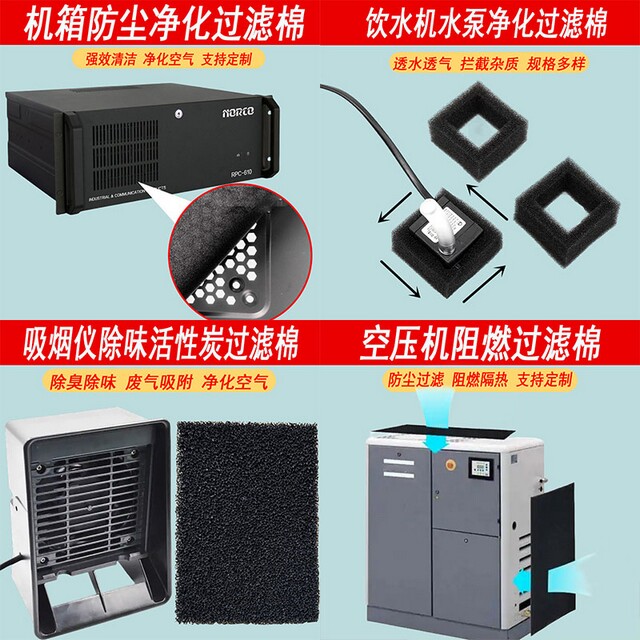
· Enclosure Dust-Proof Filter Media: Designed for industrial control enclosures, electrical equipment and power enclosures. It features high air permeability and unobstructed airflow to protect circuit boards from dust accumulation and short circuit, ensuring stable heat dissipation.
· Purifier Primary-Efficiency Filter Media: Serves as the first layer of pre-filter to intercept hair, flocs and large impurities, protecting HEPA filters and cutting the overall replacement cost, an essential consumable for purification equipment.
· Air Compressor Inlet Filter Media: Suitable for air inlets of air compressors, blowers and fan equipment. It resists wind impact, is not easy to break and offers great air permeability, blocking outdoor sand and impurities from entering the machine.
· Activated Carbon Deodorizing Filter Media: Applied to fresh air equipment, kitchen and bathroom appliances, deodorization cabinets and warehouse purification. It removes dust while absorbing odors and improves internal air quality of equipment.
· Home Appliance Dust-Proof Filter Media: Specialized for small home appliances, heat dissipation outlets and sealed air ducts. Most are customized into special shapes, small round holes or self-adhesive styles to support fast assembly on automated production lines.
Most equipment air outlets are not standard rectangles; they have special-shaped notches, positioning holes and buckle positions. Manual cutting from ordinary rolls easily causes burrs, dimensional deviation, warping during assembly and air leakage. Equipped with precision die-cutting technology, Zhongke Foam can customize filter media gaskets in arbitrary special shapes, with holes and self-adhesive backing. Mass-produced parts feature consistent dimensions, smooth edges and tight fitting for large-scale industrial supporting.
4. In-Depth Analysis of Common Selection Misconceptions
Misconception 1: Thicker filter media delivers better filtration. Thickness is not equal to filtration accuracy. Overly thick filter media with dense pores will sharply increase air resistance, reduce air volume, weaken heat dissipation, raise fan load and power consumption, and impair equipment performance instead. Misconception 2: Low-cost general filter media can replace industrial filter media. Ordinary civilian filter media has loose fibers, sheds easily and lacks aging resistance. It turns black and breaks down quickly with high dust penetration rate. It cannot meet the long-term protection standards of industrial equipment and will trigger mass after-sales failures. Misconception 3: Neglect self-adhesive backing and fitting precision. Poor bonding, warped edges and gap leakage render the filter media ineffective. Dust will penetrate through side gaps and cause dust accumulation and equipment failure. Integrated die-cut filter sheets with adhesive backing stick flat and provide strong sealing to solve dust leakage thoroughly.
5. Professional Advice on Filter Media Usage and Maintenance
Proper maintenance can extend equipment service life and cut operation costs. For industrial environments with heavy dust and complex working conditions, conduct regular inspection and replace filter media timely to avoid blocked air ducts, overheating and shutdown. Before mass customization, confirm thickness, pore size, adhesive backing and opening dimensions in advance. Test air permeability, dust accumulation and fitting performance with samples, and start mass production only after verification to eliminate batch risks at the source.
Although filter media looks simple, it is a key accessory to guarantee equipment heat dissipation, dust prevention, purification and stable operation. Material selection should focus on working condition adaptation rather than price; processing should prioritize fitting precision rather than universal specifications. Matching industrial filter media solutions are available for ordinary dust prevention, precision purification, odor adsorption, fire and moisture resistance scenarios. Zhongke Foam focuses on die-cutting customization of various filter media, supporting small-batch sampling and mass production. We provide reliable supporting services for home appliance, industrial control, purification and industrial equipment manufacturers.
Zhongke Foam Rubber Products Co., Ltd., Shunde District, Foshan City
Contact Hotline: +86 133 1833 8520 (WeChat Available) / 133 9277 3528 (WeChat Available)
Tel: 0757-26612516
Website: www.xcp181.com
Address: No.11 Cuizhu South Road, Hongqi Community, Ronggui Subdistrict, Shunde District, Foshan City, Guangdong Province, China
-----------This content was compiled and created with the assistance of AI---------